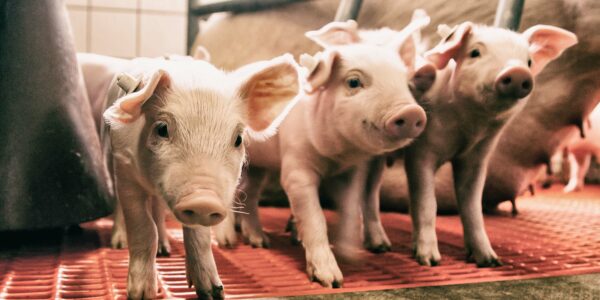
Around farrowing, sows experience one of the most demanding transitions in animal production: moving from the anabolic state of late gestation to the catabolic, milk-driven phase of lactation.
This shift is characterised by oxidative stress and energy deficits. As a result, metabolic disorders such as post-partum dysgalactia syndrome (PPDS) remain among the most frequent causes of reduced performance and piglet losses in practice.
Pigs are particularly sensitive to heat due to their physiology.
As a result, there is a risk of heat stress – a condition that is associated with a variety of negative consequences for the metabolism, health and performance of the animals.
Acidified rations are often used in sows around the time of birth. This primarily serves the purpose of lowering urinary pH values and the associated nutritive prophylaxis of metritis-mastitis-agalactia syndrome (MMA syndrome). A current trial on a sow farm shows that the use of a special product based on ammonium chloride leads to clear and rapid effects on the urinary pH value.
The challenge: In modern livestock farming, various factors challenge the optimisation of feeding. The animals are exposed to various types of stress, such as environmental factors or physiological factors. In particular, long periods of high outdoor temperatures (heat stress) place an additional strain on the metabolism, causing oxidative metabolic processes to run at full speed. […]
The challenge: For dairy cows:In recent years, many dairy farmers have already been intensively involved with the DCAB concept (DCAB: dietary-cation-anion-balance) in dry period feeding. It is known that a low DCAB in the dry period can help prevent milk fever. The effect or success in dairy cows is often measured by urine pH or […]
The challenge: For dairy cows: Breeding progress in dairy cows is continuously increasing the genetic potential for milk production. In high lactation, however, this often leads to metabolic problems and other stresses that impair health and longevity. Traditionally, feeding focusses on covering energy and nutrient requirements. For high-yielding cows, additives are mainly used to support […]
The trial clearly shows that the addition of BEWI-FATRIX® SynerG+ was able to increase colostrum quality directly after farrowing. The product can positively influence the quality of sow’s colostrum in a natural way.
Fats play an important role in animal nutrition. They serve as an energy carrier, storage medium, construction of membranes, absorption, synthesis and transport of hormones and vitamins.
Fat is the feed component with highest energy density in animal feed.
Pigs are equipped with relatively few sweat glands and thus, experience heat periods quite early as they are not able to effectively dissipate warmth. A targeted approach is important to decrease the impact of heat as much as possible.
The challenge: Breeding has significantly increased the growth- and performance potential. Not only of dairy cows and pigs but also of pigs. This goes hand in hand with a significantly higher energy requirement. For a successful economical animal farming, it is important to take care of a careful component selection. This is why highly digestible […]
The background: Due to their fast and effective energy-providing properties, medium-chain fatty acids (MCFA) are particularly important in animal nutrition. The various MCFAs serve, among other things, as an energy supplier for intestinal cells, for growth performance and for optimising the rearing. A stable feed intake and a performance-orientated energy supply for the animal form […]