
Capsaicin helps pigs deal with heat stress
Rising temperatures and more frequent extreme weather events resulting from climate change are making heat stress a persistent challenge in pig farming. Pigs are particularly vulnerable as they largely lack functioning sweat glands. As soon as the ambient temperature exceeds the thermoneutral zone, the animals’ natural thermoregulation quickly reaches its limits. The thermoneutral zone depends mainly on the age and weight of the animals and varies between approximately 15 and 28 °C.
The animals begin to pant, reduce their activity and adjust their behaviour to dissipate heat. However, this leads to increased CO₂ loss, which can affect the acid-base balance. At the same time, body temperature rises and stress hormones such as cortisol are released. The organism enters a state of increased stress that goes far beyond simple thermoregulation.
When heat becomes a metabolic problem
Heat stress is not just a problem of temperature, but primarily a metabolic one. Energy requirements increase, as mechanisms such as panting and increased blood flow to the skin actively consume energy. At the same time, feed intake decreases, meaning fewer nutrients are available for maintenance, performance and immune function.
Particularly critical is the increased formation of free radicals. Oxidative stress increases, whilst at the same time antioxidant defence systems are undersupplied. Cell structures are attacked, inflammatory processes are promoted and the body’s ability to regenerate is impaired.
In parallel, blood flow shifts towards the body’s surface. The digestive tract is less well supplied, the intestinal barrier loses stability, and increased permeability may occur. This so-called ‘leaky gut’ further exacerbates inflammatory processes and places an additional strain on the metabolism.
Capsaicinoids as a functional approach in animal feed
Against this backdrop, functional plant compounds such as botanicals are increasingly coming into focus. Capsaicinoids from Capsicum annuum offer an interesting approach here, as they act on several key mechanisms simultaneously:
- Thermoregulation:
By activating specific receptors, particularly TRPV1, they directly influence the regulation of body temperature. These receptors are involved in the perception and control of heat, enabling capsaicinoids to indirectly support thermoregulation. - Peripheral blood flow:
At the same time, they promote peripheral blood flow. This not only improves heat distribution within the body but also supports the supply of tissues and organs during a phase in which blood flow is significantly redistributed. - Feeding behaviour:
Another key effect is evident in feeding behaviour. Under heat stress, feed intake often drops significantly, which limits the supply of energy and nutrients. Capsaicinoids can positively influence appetite regulation and help to stabilise feed intake. - Antioxidant and anti-inflammatory effects:
Furthermore, their antioxidant and anti-inflammatory properties are of great significance. They help to limit the formation of free radicals and support the body in better managing oxidative stress. At the same time, they can mitigate inflammatory processes in the gut and throughout the metabolic system. - Digestion:
Last but not least, capsaicinoids have a stimulating effect on digestion. They promote the secretion of digestive juices and enzymes, which improves nutrient utilisation, particularly under stressful conditions.
Highly effective in animals, safe to process
A key advantage of BEWI-FATRIX® Fortify is the special processing of the ingredients it contains. In their pure form, capsaicinoids are not only sensitive to external factors such as heat, oxygen or light, but their pungency can also affect processing and palatability.
Our targeted production process stabilises the active components and transforms them into a form that is convincing both technologically and practically. The active ingredients are securely bound, allowing them to perform their function optimally in the animal without losing their activity during storage or processing.
At the same time, this processing ensures that there is no irritation for users. Dust formation and pungent irritants, such as those that can occur with untreated capsaicinoids, are effectively minimised. This improves occupational safety and facilitates handling in day-to-day operations.
There is also a clear advantage for the animals. The typical spiciness that can lead to acceptance issues with free capsaicinoids is minimised. As a result, feed intake remains stable, even under heat stress, when animals are already prone to reduced feed intake.
So BEWI-FATRIX® Fortify combines high biological efficiency with optimal processability and acceptance – for both the user and the animal.
Our solutions:
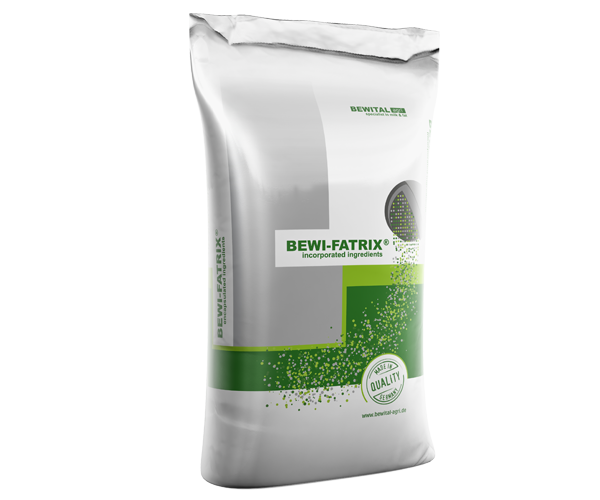
BEWI-FATRIX® Fortify is a feed supplement designed for all animal species to support the metabolism during periods of increased demand.
- Combines processed herbs (Capsicum annuum) and other botanicals
- Combines antioxidant and anti-inflammatory properties
- Promotes cell regeneration after oxidative stress
- Stimulates the animals’ appetite and promotes safe feed and nutrient intake
>> learn more about the product
Here's something else that may interest you:
-
High temperatures lead to problems in pigs

Pigs are equipped with relatively few sweat glands and thus, experience heat periods quite early as they are not able to effectively dissipate warmth. A targeted approach is important to decrease the impact of heat as much as possible.
learn more -
Heat? Adjust feeding!

It is well known that at high ambient temperature it is quite difficult to get enough energy in lactating sows. However, with an adapted feeding strategy, sufficient energy intake can be ensured even in summer, when temperatures are high.
learn more