
From “milk-digester” to ruminant
During the first few weeks of life, calves undergo a fundamental physiological transformation, evolving from monogastric digestion to becoming fully functional ruminants. This also changes the source of amino acids required for growth and metabolism.
What changes in calves as their concentrate intake increases
Newborn calves obtain their amino acids almost exclusively from whole milk or calf milk, as the rumen is initially barely active.
As the intake of concentrate increases, microbial fermentation begins in the rumen. This process produces not only volatile fatty acids, which are essential for the development of the rumen, but also microbial protein, which later makes an important contribution to the supply of amino acids.
During calf rearing, from the 5th to 6th week of life, the amount of milk fed is usually reduced, whilst the intake of solid feed increases. Analyses show that the proportion of microbial protein in the total protein flow to the intestine rises sharply as the intake of calf starter/calf concentrate increases.
If a calf eats around 1.3 kg of starter feed per day, approximately 60% of the protein in the small intestine is of microbial origin. At this stage, the metabolism is already functioning largely as in a fully grown ruminant.
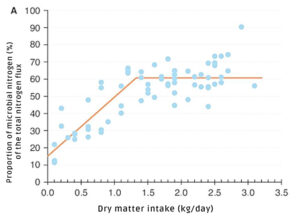
Figure 1: Changes in microbial nitrogen flux in the gut, shown as a percentage (%) of total nitrogen. Source: NASEM (2021), Nutrient Requirements of Dairy Cattle.
Importance for protein and amino acid intake
During the rearing period, the source of the protein available in the gut changes significantly.
In the first few weeks of life, whole milk or calf milk provides virtually all the amino acids. However, as starter intake increases, the proportion of microbial protein and rumen-stable feed protein rises significantly. At the same time, the supply of amino acids from the digestion of solid feed becomes increasingly important.
The amino acid composition of microbial protein is considered largely optimal for calf growth. In the case of undegraded feed protein, however, particular attention should be paid to ensuring a high-quality composition.
Ensuring an adequate protein supply throughout the calf-rearing process
To fully realise the calves’ genetic growth potential, it is crucial to ensure a nutrient supply tailored to their needs throughout the entire rearing period. The weaning phase and the transition to solid feed are particularly important. During this time, the supply of protein and amino acids must be specifically ensured.
In addition to suitable calf milk, attention should therefore also be paid to the protein supply via the calf concentrate. Crucial factors here are not only palatability and a sufficient energy supply for the growth of rumen microbes, but also the protein content and the composition of the undegraded feed protein.
In practice, a protein content of around 20% in the calf TMR and the targeted use of rumen-protected protein sources, such as protected rapeseed meal, have proven effective.
Here's something else that may interest you:
-
What does the calf need for 1,000 g daily weight gain?
Successful and performance-orientated calf rearing requires an intensive feeding regime. From the outset, the development of female calves should be geared towards the goal of a healthy, fertile dairy cow with a high lifetime yield. In addition to muscle growth, the focus is therefore particularly on the development of vital udder and reproductive tissue.
learn more -
Interview with Klaus Dann – A look behind the scenes
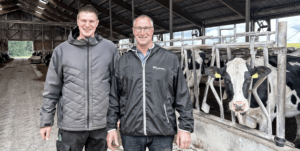
Klaus Dann provides insights into the feeding and health management of his farm and shows how he achieves sustainable top performance. With genomic selection, high-quality feed and a clear strategy, he has built a high-performance herd. BEWI-MILK® AM 5 plays a key role during the milk-feeding phase, helping set the course for future performance early on.
learn more -
Amino acid supply in young calves
For optimal calf growth, not only the amount of feed matters, but also nutrient quality. Only then will weight gain be converted not just into fat, but into muscle mass and organ development. A daily intake of 300 to 320 g of crude protein is necessary. Even more important is protein quality – the composition of its amino acids.
learn more