
Amino acid supply in young calves
Optimal growth in calf rearing depends not only on the amount of milk fed. The quality of the nutrients is also crucial. Only then will weight gain be directed not just towards fat, but also towards muscle development and organ growth.
A daily intake of at least 300 to 320 g of crude protein is necessary for this. ven more important, however, is the quality of the protein, i.e. the composition of the amino acids it contains.
Newborn calves initially function like monogastric animals and obtain their amino acids mainly from whole milk or calf milk. Natural milk protein is considered the optimal source of nutrients for calves, as its amino acid profile very well meets the requirements for growth and maintenance.
Sources of protein in calf milk
Various protein sources are used in the production of calf milk, some of which differ significantly in their amino acid profiles.
Milk and whey proteins contain around 8 to 9% lysine in crude protein, whilst wheat protein contains less than 2%. These differences have a direct impact on the calf’s nutritional intake.
For this reason, plant-based protein sources in calf milk are often specifically supplemented with lysine and methionine to ensure a balanced amino acid profile that meets the calf’s requirements.
Sources of protein in calf milk
In addition to composition, the technological processing of the raw materials also plays a crucial role.
Excessively high temperatures or damage during drying can significantly reduce the digestibility of proteins and amino acids. As a result, the young calf has less usable protein available for growth and development.
Digestibility is particularly important for young calves. Milk and whey proteins are significantly more readily available here than plant-based protein sources such as soya protein concentrates.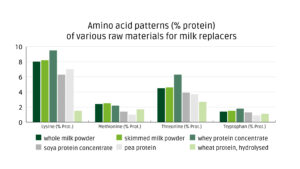
Amino acid profile of calf milk
In addition to protein content, the amino acid composition is also crucial for ensuring that the calf’s nutritional needs are met.
Current recommendations (NASEM, 2021) and milk protein as a natural benchmark serve as a guide. This results in optimal target values for individual amino acids depending on the protein content of the calf milk (see Figure 1).
For example, calf milk with a protein content of 25% should contain around 2.05% lysine. With a protein content of 22%, the target should be around 1.80% lysine.
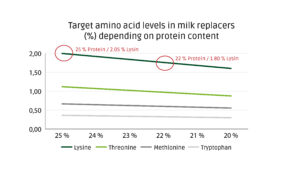
Figure 1: Target amino acid levels in calf milk (%) as a function of protein content
Practical implications for calf feeding
To ensure the calves develop optimally, several factors should be taken into account when planning the feeding strategy:
- high-quality, easily digestible sources of protein (milk and whey products)
- balanced amino acid profile, particularly with regard to lysine and methionine
- consistent raw material quality
- early introduction of starter feed to promote rumen development
Here's something else that may interest you:
-
What does the calf need for 1,000 g daily weight gain?

Successful and performance-orientated calf rearing requires an intensive feeding regime. From the outset, the development of female calves should be geared towards the goal of a healthy, fertile dairy cow with a high lifetime yield. In addition to muscle growth, the focus is therefore particularly on the development of vital udder and reproductive tissue.
learn more -
Interview with Klaus Dann – A look behind the scenes

Klaus Dann provides insights into the feeding and health management of his farm and shows how he achieves sustainable top performance. With genomic selection, high-quality feed and a clear strategy, he has built a high-performance herd. BEWI-MILK® AM 5 plays a key role during the milk-feeding phase, helping set the course for future performance early on.
learn more -
From “milk-digester” to ruminant

During the first few weeks of life, calves undergo a fundamental physiological transformation, evolving from monogastric digestion to becoming fully functional ruminants. This complex developmental transition also changes the source and availability of essential amino acids required for optimal growth, metabolism, and overall health.
learn more