
Higher weight gains due to slow-milk-flow-teats
The feeding phase is crucial for the development of calves. Animals with high genetic potential in the first weeks of life need sufficient energy and protein to reach their full growth potential. At the same time, feeding systems place high demands on management, animal welfare and the monitoring of animal health.
Results from a practical study with slow-milk-flow-teats
A new study by the South Westphalia University of Applied Sciences (Germany), in partnership with BEWITAL agri, shows how a controlled-full feeding strategy, combined with slow-milk-flow-teats, can positively influence calf growth and behaviour.
The results were published in October 2025 at the 63rd BAT Conference in Poing/Grub (Germany) and presented as a scientific poster.
Current situation in calf rearing
In practice, different feeding systems are used. Restrictive feeding systems are easy to control, but often do not fully meet the needs of high-performance calves. Ad libitum systems allow for high milk intake, but pose challenges in terms of hygiene, significant fluctuations in milk intake and assessing health status.
Between these two strategies, controlled feeding is increasingly coming into focus. The aim is to offer calves a milk quantity that meets their needs, based on their voluntary intake, but without permanent free access to the feeder.
Aim of the study
The aim of the study entitled “Influence of selected feeding systems on the behaviour and growth of calves up to 12 weeks of age” was to investigate the influence of different feeding systems on the growth and behaviour of calves under practical conditions.
The focus was on the question of whether controlled full feeding to satiety in combination with slow-milk-flow-teats offers measurable advantages over rationed calf milk allocation.
Trial setup in practice
The study was done on a dairy farm in North Rhine-Westphalia, Germany.
- Trial duration: 84 days
- German Holstein calves
- Comparison of two groups
- Control group with rationed feeding via teat buckets with standard teats
- Test group with controlled full feeding via a milk bar system using slow-milk-flow-teats with increased suction resistance
BEWI-MILK® AM 9 calf milk was used in both test groups.
From the 14th day of life, the calves were kept in groups. In the trial group, the milk bar was removed after 30 minutes. The control group continued to be fed rationed milk via the teat bucket.
From day 57 onwards, the calves were gradually weaned. In addition, calf dry TMR, hay and water were available at all times. Weight development, calf milk and TMR intake, behavioural parameters and calf health were recorded.
Key findings of the study
Higher weight gains
The calves in the controlled-full feeding trial group consumed more calf milk and converted it efficiently into growth. On day 84, they weighed almost 10 kilograms more than the calves in the control group.
Calmer behaviour
The calves in the experimental group exhibited significantly calmer activity patterns. Vocalisations and stress-related behaviours such as mutual suckling occurred less frequently.
Natural suckling behaviour
The use of slow-milk-flow-teats significantly increased the feeding time. The drinking speed was approximately 4.2 minutes per litre of calf milk compared to 1.8 minutes per litre with conventional teats. The longer suckling time led to increased salivation and better satisfaction of the suckling need.
Why difficult-to-use teats matter
Slow-milk-flow-teats slow down the flow of milk and prolong feeding time. The calf sucks longer and more intensively, which is closer to natural sucking behaviour. This results in more physiological satiety.
In combination with controlled full feeding, the calves’ sucking needs are better satisfied. Stress symptoms decrease and the calves are generally calmer in the barn.
Conclusion for practice
The results of the study show that calves are able to convert higher quantities of calf milk into growth in a meaningful way when the feeding concept and technology are matched.
Controlled full feeding in combination with a milk bar system and slow-milk-flow-teats offers clear advantages:
- Higher daily weight gains
- Calmer behaviour of the calves
- Reduction in stress-related symptoms
- Good controllability of calf milk intake
This feeding concept is a practical and animal-friendly alternative, especially for farms with high-performance calves.
Here's something else that may interest you:
-
Ad libitum, restrictive or controlled full feeding
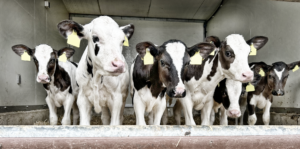
Ad libitum, restrictive or controlled full feeding? Recommendations from the USA and Germany show calves with high genetic potential need more energy and protein to reach full growth potential. In practice, different feeding systems are used. The Milchbar feeding system, combined with controlled feeding, showed advantages in calf development and welfare.
learn more -
What does the calf need for 1,000 g daily weight gain?
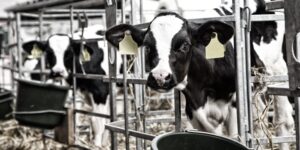
Successful and performance-orientated calf rearing requires an intensive feeding regime. From the outset, the development of female calves should be geared towards the goal of a healthy, fertile dairy cow with a high lifetime yield. In addition to muscle growth, the focus is therefore particularly on the development of vital udder and reproductive tissue.
learn more -
Colostrum supply – “Four golden rules”
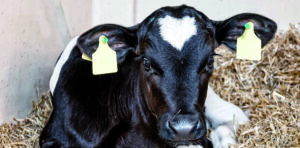
Calves do not receive any immunoglobulins in the womb via the cow's uterus. This means that immediately after birth, they are completely dependent on colostrum to build up their initial immunity. An inadequate supply of immunoglobulins in the first few hours of life has serious consequences: Immunodeficiency, high losses, poor weight gain and rising treatment costs are inevitable.
learn more