
Ad libitum, restrictive or controlled full feeding
Current recommendations from the USA (NASEM, 2021) and Germany (LfL, 2021) clearly show that calves with high genetic potential need more energy and protein to reach their full growth potential. In practice, different feeding systems are used for this purpose.
Ad libitum
With an ad-libitum feeding system, milk is always available for the calf. Studies show that calves consume significantly higher amounts of milk this way than with a restrictive feeding system. While this sounds positive at first, it also presents challenges.
A permanently filled drinking bucket significantly increases the risk of bacterial contamination. In addition, recent studies show that very high milk intake of up to 14 litres per day often leads to significant variations in the amount of milk (Trautner and Hovenjürgen, 2026). On subsequent days, intake sometimes drops to 4 to 6 litres without the calves appearing ill. This makes it difficult to assess animal health based on milk intake alone.
The key finding: between the third and sixth week of life, calves fed ad libitum did not show higher daily weight gains than calves fed a limited amount of milk (around 10 litres per day).
Restrictive
With restrictive feeding, milk quantities and feeding times are clearly limited. The system is easy to control, but often does not cover the actual energy and protein requirements of high-performance calves.
Controlled full feeding: The middle way with clear advantages
More and more farms are turning to controlled full feeding. This combines the advantages of both systems. The calves receive a physiologically appropriate amount of milk based on their voluntary intake, but without being given free access to the feeder throughout the day.
A recent study conducted in collaboration with the South Westphalia University of Applied Sciences (Department of Agricultural Economics in Soest, Germany) examined precisely this concept. It compared controlled ad libitum feeding with up to 11 litres of milk per day with restrictive feeding of a maximum of 8 litres.
The result is clearly relevant in practice:
- Higher energy and protein intake
- Significantly higher daily weight gains
- Approximately 10 kg additional weight on day 84
- Calmer calves with improved well-being
In the practical implementation of controlled feeding, a milk bar system with slow-flow teats was used. In a direct comparison, the slow-flow teat resulted in a significantly lower drinking speed during the main feeding phase, at 4.2 minutes per litre, compared to the conventional teat (1.8 minutes per litre).
Conclusion for practice:
The Milchbar feeding system, combined with controlled feeding, demonstrated advantages in both calf development and animal welfare. The calves were calmer overall and showed increased salivation.
Here's something else that may interest you:
-
What does the calf need for 1,000 g daily weight gain?

Successful and performance-orientated calf rearing requires an intensive feeding regime. From the outset, the development of female calves should be geared towards the goal of a healthy, fertile dairy cow with a high lifetime yield. In addition to muscle growth, the focus is therefore particularly on the development of vital udder and reproductive tissue.
learn more -
Higher weight gains due to slow-milk-flow-teats

A recent practical study conducted by the South Westphalia University of Applied Sciences in collaboration with BEWITAL agri shows how a controlled full feeding strategy combined with slow-milk-flow-teats can have a positive effect on calf growth and behaviour.
learn more -
Interview with Klaus Dann – A look behind the scenes
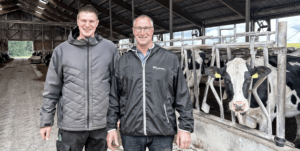
Klaus Dann provides insights into the feeding and health management of his farm and shows how he achieves sustainable top performance. With genomic selection, high-quality feed and a clear strategy, he has built a high-performance herd. BEWI-MILK® AM 5 plays a key role during the milk-feeding phase, helping set the course for future performance early on.
learn more